


THE PROJECT DOES NOT END AT THE POOL EDGE
A swimming pool begins with a balance between architecture and engineering. Form, structure, lining, water circulation, filtration, water treatment, heating, pool cover and automation are designed as a single system.
Fulcor coordinates every element from the outset, according to the available space, the intended use and future operation. The result combines a pool that is integrated into the architecture with reliable pool plant designed to maintain water quality, comfort and ease of operation over time.
FULCOR BY YOUR SIDE: A CLEAR PROCESS AT EVERY STAGE
FROM THE INITIAL SITE SURVEY TO LONG-TERM MAINTENANCE
Every project is developed around the actual conditions of the site, the building and the technical systems.
01 — CONSULTATION AND SITE SURVEY
We gather objectives, dimensions, access requirements, intended use, technical constraints and the available information.
02 — DESIGN
We define the pool, circulation system, plant room, water treatment, heating, pool cover, lighting and technical provisions.
03 — COORDINATION
We work with clients, architects, engineers and contractors to ensure that the various trades are correctly integrated.
04 — INSTALLATION
We install the systems and components within our scope, in coordination with the other works specified in the project.
05 — SET-UP AND COMMISSIONING
We start up the system, verify its operation and apply the settings best suited to the pool.
06 — ONGOING OPERATION
Inspections, planned maintenance and technical support ensure that the system remains efficient, reliable and correctly adjusted over time.
EVERY USE REQUIRES A DIFFERENT DESIGN
Space, the number of users, temperature, continuity of operation and the management approach all shape the requirements of a swimming pool. For this reason, every project begins with its actual context.

PRIVATE SWIMMING POOLS
Indoor and outdoor swimming pools designed in relation to the home, the landscape and the way they will be used.
HOTELS AND WELLNESS
Solutions for hotels, serviced residences and wellness facilities, with particular attention to comfort, continuity of operation and operation of the pool plant.


PUBLIC SWIMMING POOLS
Systems for schools, sports centres and community facilities, developed in collaboration with the project team according to the intended use and applicable regulations.
POOL CONFIGURATION
HOW THE POOL RELATES TO ITS SETTING SHAPES THE DESIGN
Shape, dimensions, ground conditions, load-bearing capacity, access and the construction schedule guide the choice of construction system.
Fulcor assesses each solution in relation to the architecture, intended use and actual site conditions.
IN-GROUND
Fully set into the ground, the pool volume integrates into the landscape and the pool edge remains level with the surrounding outdoor spaces.


PARTIALLY IN-GROUND
Only part of the pool is set into the ground, allowing the design to follow changes in level and slopes while enhancing the architecture of the site.
ABOVE-GROUND
Installed entirely above ground level, it leaves the external volume of the pool visible and reduces the need for excavation.


ON A TERRACE OR ROOF
The pool is designed in relation to the load-bearing structure, structural loads, access and technical services, ensuring that it is properly integrated into the elevated space.
CONSTRUCTION SYSTEMS
THE RIGHT STRUCTURE STARTS WITH THE DESIGN
The shape and dimensions of the pool, ground conditions, site access, construction timescales and intended use guide the choice. Fulcor assesses the construction system together with the required building works, pool plant and final lining.


01 — REINFORCED CONCRETE
HOW IT IS BUILT
The pool is built on site with a base slab and walls that are sized, reinforced and cast in accordance with the design. Its shape, depth, steps, seating and details can all be custom-designed.
WHEN TO CONSIDER IT
When the project calls for a high degree of customisation, unusual geometries, large dimensions or specific structural and usage requirements.
02 — PREFABRICATED ONE-PIECE POOL
FEATURES
The pool is manufactured in the factory as a single shell and arrives on site already formed, ready to be placed on the prepared base and connected to the pool circulation and treatment system.
In the residential sector, one of the most widely used solutions is fibreglass, a composite material reinforced with glass fibre. One-piece pools are also available in polypropylene and other thermoplastic materials, stainless steel, acrylic or specialist composites. The material, configuration and finish are selected according to the requirements of the project.
Unlike modular structures, the pool is not made from panels or structural elements that have to be assembled on site.
WHEN TO CONSIDER IT
This system is worth considering when shorter installation times and a pool manufactured under controlled conditions are required, reducing the structural work to be carried out on site. Access, transport, lifting, shell dimensions and material must all be assessed in relation to the site and intended use.
03 — MODULAR STRUCTURES
This category includes solutions made from prefabricated elements, blocks or panels that are assembled and connected on site to form the pool structure. Depending on the selected system, high-density EPS, treated timber, stainless steel, composite materials or polymers may be used.
EPS
High-density EPS elements make it possible to construct walls, the pool floor, steps, seating and integrated plant compartments using a lightweight, thermally insulated structure. The system is completed with the reinforcement, waterproofing and finishing layers specified in the design.
WHEN TO CONSIDER IT
When the low weight of the pool structure, insulation and ease of transport and assembly are key factors, particularly on terraces, rooftops and upper-floor locations, indoors and in spaces with difficult access.
TIMBER
Prefabricated elements made from suitably treated timber are assembled to form the pool structure, which is then protected internally by a waterproof lining.
WHEN TO CONSIDER IT
When an above-ground or partially in-ground pool with a natural appearance is required, well integrated into the landscape, taking account of exposure and the maintenance needs of the material.
STAINLESS STEEL
Prefabricated stainless-steel panels and elements are assembled, joined or welded to create a precise, customisable structure. The grade of stainless steel and the finish are specified according to the environment, temperature and water treatment.
WHEN TO CONSIDER IT
When the project requires high dimensional accuracy, hygiene, durability and reduced on-site work, including in public pools, hospitality facilities and architecturally complex projects.
COMPOSITE AND POLYMER MATERIALS
Panels and elements made from composite or polymer materials make it possible to create modular structures that are resistant to moisture and weathering. The load-bearing system, waterproofing and finish are specified according to the selected product.
WHEN TO CONSIDER THEM
When modularity, rapid assembly, weather resistance and low maintenance requirements are priorities.
WATER CIRCULATION SYSTEMS
THE WATER LEVEL SHAPES THE DESIGN
There is no single system that is best in every situation. The choice depends on the architecture, finished levels, available plant-room space, use, maintenance requirements and desired aesthetic result.

01 — SKIMMER
Water is drawn through skimmers set into the pool walls. It is a simple, versatile solution that must be sized according to the shape of the pool and its intended use.
02 — OVERFLOW WITH PERIMETER CHANNEL
Water flows over the pool edge and is collected in a perimeter channel or slot. It creates a visually continuous surface and requires purpose-designed pool hydraulics, including a balance tank.
The edge and channel can be designed in different geometries, selected according to the use of the pool, water level, wave control, available space and desired aesthetic result.
FINNISH SYSTEM
The sloping edge guides the water into the covered channel, reducing wave reflection back into the pool. The water level remains high, and the integrated handhold makes it easier to exit the pool. It is particularly suitable for sports pools, public pools and heavily used facilities, but can also be used in private settings.
WIESBADEN SYSTEM
The overflow edge, handhold and collection channel are integrated into a compact solution. The available configurations allow it to be adapted to public pools, hotel facilities, wellness centres and private pools.
HIGH-LEVEL EXTERNAL OVERFLOW
Water flows over the raised edge, down the outside of the pool and into a channel at a lower level. This configuration allows a very high water level and can create a striking panoramic effect.


03 — INFINITY EDGE
One or more sides open visually towards the landscape. The seamless effect is achieved through precise coordination between the structure, levels, water collection and architectural setting.
WATER TREATMENT
WATER QUALITY STARTS WITH DESIGN
Clear water is the visible outcome of a broader balance. Filtration, disinfection, pH control and parameter monitoring must operate as one integrated system.
Pool volume, temperature, bather load, indoor or outdoor setting, continuity of use and applicable requirements determine the most appropriate treatment. Not every solution is suitable or permitted for every application: private, public and communal pools require different criteria.

01 — CHEMICAL DOSING
Chlorine · Bromine · Active oxygen-based products
FEATURES
The disinfectant and the chemicals required for water balance control are dosed in controlled quantities. Chlorine is the standard disinfectant; bromine and active oxygen-based products may be considered in specific situations, depending on the intended use and applicable requirements.
Treatment effectiveness also depends on maintaining the pH within the correct range, effective circulation and filtration, and regular water testing.
WHEN TO CONSIDER IT
This is a versatile solution, suitable wherever a precise and verifiable level of disinfection is required. The product, dosage and control method are defined according to the temperature, intensity of use, indoor or outdoor setting and the requirements applicable to the pool.

02 — SALT ELECTROLYSIS
Chlorine generation from sodium chloride
FEATURES
A controlled quantity of salt is dissolved in the water. As the saline water passes through the electrolytic cell, chlorine is generated from chloride ions directly within the circulation system.
This is therefore not a chlorine-free system, but a method of generating chlorine in situ that reduces the need to store and handle chlorine-based chemicals. Salt concentration, pH, cell output and the free chlorine level must still be monitored.
WHEN TO CONSIDER IT
It is particularly suitable when consistent treatment that can be automated is required, especially for private pools. Material compatibility, metal components, pool linings, covers and operating conditions must be considered from the design stage.


03 — FULCOR ELECTROPHYSICAL SYSTEM
Controlled copper–silver ionisation
The Fulcor electrophysical system uses copper and silver electrode assemblies integrated into the water treatment system. Developed and patented by Fulvio Cortesi, it was created to provide an alternative to conventional chlorination for private pools.
The system must be correctly sized according to pool volume, water circulation and intensity of use. Calibration, regular checks and ongoing maintenance are integral parts of the system.
WHEN TO CHOOSE IT
This solution is designed for private pools and for those who wish to avoid chlorine, its characteristic odour and the sensation it can leave on the skin after swimming. Fulcor assesses its feasibility according to the characteristics of the pool and its technical systems.
POOL LININGS AND FINISHES
MATERIAL, COLOUR, REFLECTION


CHARACTERISTICS AND APPLICATIONS
THE RIGHT POOL LINING DEPENDS ON THE PROJECT
The lining defines the character of the pool, while the perceived colour of the water is created by the combined effect of depth, light, exposure and the surrounding environment. The substrate, temperature, water treatment, type of use and maintenance requirements guide the choice of material and finish.
01 — PVC LININGS — Standard liner · Reinforced membrane
FEATURES
Both solutions waterproof and line the pool, but they differ in structure and installation method. A standard liner is a single-layer PVC membrane manufactured to the pool’s dimensions and subsequently installed in the pool. A reinforced membrane contains an internal polyester mesh and is welded directly on site.
WHEN TO CHOOSE THEM
A standard liner is particularly suitable for pools with regular geometries and when a bespoke, factory-made solution is required. A reinforced membrane can be adapted directly to complex shapes, steps, seats and details, and is suitable both for new pools and for the renovation of existing ones.
The choice is based on the pool structure, geometry, water temperature, intensity of use and the slip-resistance requirements of the different areas.
AVAILABLE FINISHES
Standard liner: solid colours and traditional decorative patterns.
Reinforced membranes: solid colours, decorative patterns, textured finishes, 3D embossing and slip-resistant versions for steps, seats and shallow-water zones.
02 — MOSAICS AND CERAMIC TILES — Vitreous glass mosaic · Ceramic tiling
FEATURES
Mosaics and ceramic surfaces are modular finishes that provide extensive freedom in the choice of colours, geometries and details. The small tesserae of vitreous glass mosaic adapt precisely to curves, steps and complex shapes, creating reflections and variations in colour. Ceramic tiling creates more regular surfaces and allows a consistent architectural language to be maintained between the pool, its edges and the surrounding spaces.
WHEN TO CHOOSE THEM
When a high degree of aesthetic customisation, precise detailing and a rigid, durable finish are required. They are particularly suitable for concrete pools with a stable, correctly prepared and waterproofed substrate.
Materials, grout and installation methods are defined according to the water temperature and treatment, intensity of use, cleaning requirements and the slip-resistance requirements of the different areas.
AVAILABLE FINISHES
Vitreous glass mosaic: solid colours, colour blends, gradients and decorative compositions.
Ceramic tiling: different formats, colours and textured effects, with smooth or slip-resistant surfaces selected according to the area of application.
03 — NATURAL STONE
FEATURES
Every natural stone element has its own shades, veining and variations, making each finish unique and allowing it to integrate harmoniously with the architecture and landscape.
The stone must be selected specifically for use in swimming pools, taking into account its porosity, water absorption, durability and compatibility with permanent immersion and water treatment.
WHEN TO CHOOSE IT
When an authentic, tactile result with a strong connection to its surroundings is desired. It is particularly suitable for projects in which the pool floor, walls, steps and seats contribute to creating a coherent and refined architectural design.
The choice is assessed individually, taking into account the pool’s characteristics, climatic conditions, water temperature and treatment, cleaning requirements and the safety of the different areas.
FORMATS AND SURFACE TREATMENTS
Slabs, modular formats and bespoke elements for the pool floor, walls, steps and seats.
Surfaces may be honed, brushed or textured. In pedestrian traffic areas, on steps and in shallow-water zones, finishes with suitable slip-resistant properties are preferred.
04 — GRANITE — Smooth granite · Bush-hammered granite
FEATURES
Granite is a compact and durable natural stone, characterised by variations in grain and tone that make every surface unique. It allows bespoke linings and elements to be created with a precise, tactile and strongly architectural appearance.
The type of granite and installation system must be selected with consideration for permanent immersion, water absorption, temperature fluctuations, frost and compatibility with the water treatment system. The surface treatment also determines the appearance, grip and cleaning requirements.
WHEN TO CHOOSE IT
When a natural, robust and understated finish with a lasting visual presence is desired. It is suitable for private and public pools in which durability, precision of workmanship and architectural continuity must coexist.
Smooth granite creates more uniform surfaces and enhances the reflections of the water. Bush-hammered granite has a more pronounced texture and provides greater grip, making it particularly suitable for steps, shallow-water zones and wet traffic areas.
FORMATS AND SURFACE TREATMENTS
Slabs, modular formats and bespoke elements for the pool floor, walls, steps and seats.
Dimensions, thicknesses, joints and surface finish are defined according to the selected granite, the area of application and the pool’s technical and safety requirements.
05 — CONCRETE — Smooth fair-faced concrete · Coated concrete
FEATURES
Concrete can form both the structure and the visible finish of the pool. The quality of the concrete pour, waterproofing, crack control, joints and substrate preparation determine the continuity, appearance and durability of the finished surface. Coated finishes require coating systems specifically designed for continuous immersion and water treatment.
WHEN TO CHOOSE IT
When a pared-back, tactile and contemporary result is required, fully integrated into the architecture and created entirely to measure.
FINISHES
Smooth or lightly textured fair-faced concrete; coated surfaces in different colours; slip-resistant finishes for steps and shallow-water zones.
06 — STAINLESS STEEL
FEATURES
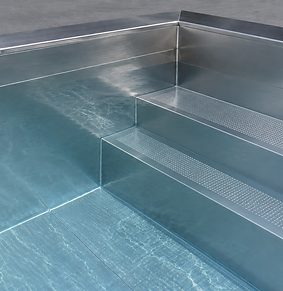
Stainless steel makes it possible to create a continuous, precise and completely bespoke pool, integrating the floor, walls, steps, seats and technical details. Free from traditional grout joints, the metal surface reflects light in a distinctive way and gives the water a crisp, contemporary appearance.
The smooth, non-porous surface facilitates cleaning and visual inspection of the pool. Its durability depends on selecting the correct alloy, the quality of fabrication and maintaining the water quality parameters within the specified limits.
WHEN TO CHOOSE IT
When a pared-back, technical and strongly architectural result is required, combining dimensional accuracy, customisation and ease of maintenance.
It is suitable for private, hotel and public pools, including those subject to intensive use. It may be considered both for new pools and for the renovation of existing ones, provided that the structure and project conditions allow it.
FABRICATION AND DETAILS
There is no single grade of stainless steel suitable for every pool. The alloy is selected according to chloride levels, temperature, water treatment, the indoor or outdoor environment and intensity of use.
AISI 316L stainless steel is commonly used in conventional pools, while saline, thermal or particularly aggressive water may require alloys with greater corrosion resistance.
Sheets, thicknesses, reinforcements and construction details are engineered according to the structure. Welds must be executed, inspected and finished with particular precision. Subsequent treatments remove oxides and contaminants produced during fabrication and restore the steel’s protective passive layer.
Walls and vertical surfaces may have a uniform satin finish, while textured finishes with suitable slip-resistant properties are specified for pool floors, steps and shallow-water zones.
CONTROL AND AUTOMATION
DIFFERENT FUNCTIONS, COORDINATED CONTROL
Filtration, water quality, temperature, lighting and in-pool features can be controlled individually or as part of a coordinated system. The level of automation is determined by the system configuration, the way the pool is used and the required level of autonomous operation.
WATER CIRCULATION AND FILTRATION
Programming operating cycles, controlling pumps and adjusting run times allow the system to be matched to the pool’s use and seasonal conditions.
TEMPERATURE AND EFFICIENCY
Water temperature and heating schedules can be programmed around usage. Where the system is configured accordingly, operation can also be coordinated with the pool cover to reduce heat loss and unnecessary run time.
LIGHTING AND SCENES
Pool lighting can be scheduled and, where supported by the system, intensity, colours and sequences can be combined into different lighting scenes.
IN-POOL FEATURES
Hydromassage, counter-current swimming systems, waterfalls and other water features can be activated, timed and coordinated according to the pool configuration.
REMOTE MONITORING AND CONTROL
Connected controllers allow key operating parameters and plant status to be viewed remotely, readings to be logged and any faults to be flagged. By agreement with the client, Fulcor can also access the system remotely to check operation, adjust settings and support day-to-day management, making service faster and more targeted.
WATER TREATMENT AND QUALITY
Water analysis, dosing and disinfectant generation can be managed manually, through timed programmes or automatically using sensors and controllers.
MANUAL
Testing, dosing and corrections are carried out by the operator according to a defined programme.
SEMI-AUTOMATIC
Dosing or disinfectant generation is started and timed automatically, while some checks and corrections remain manual.
AUTOMATIC
Sensors and controllers monitor water quality parameters and control dosing or disinfectant generation based on the configured setpoints. The system can also log readings and flag faults or out-of-range conditions.
The level of automation is selected according to continuity of operation, bather load and the chosen management approach. Automation improves consistency and precision, but does not replace periodic checks, sensor calibration or system maintenance.
EQUIPMENT
PROTECTION, COMFORT AND FUNCTIONALITY

01 — POOL COVERS
A correctly selected pool cover protects the water, limits debris ingress and reduces evaporation and heat loss. Manual or automatic solutions, with cover mechanisms housed within the pool structure or installed externally, are assessed according to the pool geometry, use, available space and safety requirements.

02 — ACCESS AND SAFETY
Ladders, steps, handrails and slip-resistant surfaces shape how users enter and exit the pool and move safely around it. Their form, position and materials are defined according to the users, water depth and type of pool, coordinating safety, comfort and integration with the pool.

03 — COMFORT AND IN-POOL FEATURES
Submerged seating, shallow-water shelves, relaxation zones, hydromassage and counter-current swimming systems transform the pool into a space tailored to the habits of those who use it. Each feature is coordinated from the design stage with the structure, circulation pipework and pool plant.

04 — LIGHTING AND ATMOSPHERE
Lighting enhances the shape of the pool, its materials and the movement of the water, improving visibility and defining the atmosphere after dark. Position, direction, intensity and light colour are designed in relation to the architecture and use, while minimising shadowed areas and glare. Where supported by the system, switching schedules and lighting scenes can be integrated into the pool’s control and automation system.
05 — HEATING AND EFFICIENCY
Water temperature affects comfort, the length of the swimming season and the system’s energy consumption. The heating system is sized according to pool volume, desired temperature, period of use, exposure and available energy sources. Proper control, combined with the pool cover and scheduling, helps reduce heat loss and unnecessary operation.
SERVICES FOR YOUR SWIMMING POOL
PRESERVING THE VALUE OF YOUR POOL OVER TIME
From renovating an existing pool to the planned operation and maintenance of the pool plant, Fulcor helps preserve the pool’s quality, efficiency and reliability over time.
RENOVATION
An existing pool can be renewed in ways that go beyond appearance. Fulcor assesses the condition of the pool and its pool plant to identify the work that is genuinely needed: from renewing the lining and pool edge to upgrading circulation, automation and the plant room.
Renewal of linings and finishes
Modification of the pool edge and circulation system
Upgrades to pool plant and automation
Plant room refurbishment and efficiency improvements
MAINTENANCE AND SERVICE
Regular checks and correct settings preserve water quality, efficiency and reliability over time. Fulcor maintains and supports the pool plant through scheduled visits, seasonal services and technical support tailored to the pool’s characteristics and use.
Where the pool plant is equipped with connected controllers, we can also monitor operating parameters and adjust settings remotely, making support faster and more targeted.
System checks, water testing and adjustments
Seasonal opening and winterisation
Planned maintenance and service plans
Remote monitoring and technical support